
- Home
- TPO Roofing

TPO Roofing in South Fulton, GA
A TPO roof starts with the building use and the roof zone. A distribution building has a wide field and few penetrations. A flex building adds office wings and rooftop units. Each zone changes where the seams run, where the fasteners sit and where a crew can stage. South Fulton has long hot summers and a spring storm peak, so the sheet works hard every year.
TPO is a thermoplastic single-ply membrane, usually white, with seams joined by hot-air welding. The weld is the mechanism that matters. A good weld fuses two sheets into one. A cold weld only sticks, and it opens when the sheet moves. Our first walk probes the seams, maps the attachment and records the condition by roof zone.
South Fulton's established business districts sit on Roosevelt and Old National highways, and the city counts part of the Camp Creek industrial-commercial area within its limits. The development authority advertises industrial parks, flex space, mixed-use areas and professional office corridors. Any of those can carry a TPO roof, and the roof is read on site, layer by layer.
Roof mechanism: how TPO fails
TPO fails in four common ways. Seams open where welds were cold or dirty. The surface crazes when heat and sun age the top layer. The sheet shrinks and pulls away from walls and curbs. Punctures follow foot traffic and dropped tools. Each leaves a different mark. Open seams show as lifted edges. Shrinkage shows as tented flashings and bare gaps at terminations.
NOAA calls Georgia summers long, hot and humid, and counts about seven days a year above 95 degrees Fahrenheit in Atlanta. That is a regional signal. It tells us the sheet cycles through heat daily from late spring through early fall. It cannot describe the condition of a single roof, so the probe and the photographs come first.
Foot traffic matters too. Service routes to rooftop units wear the sheet faster than the field. We mark those routes and add walk pads where the surface shows scuffing. A pad costs little against a patch and a wet ceiling. Pads are placed with gaps so water does not pond behind them.
Attachment: mechanical, adhered or ballasted
How the sheet is held down sets the repair. A mechanically attached sheet rides on fasteners and plates in rows. Wind can lift it between rows, and plates can work through the sheet. An adhered sheet is bonded to the substrate. Failure shows as blisters or lifted flaps. A ballasted sheet is held by stone and shows bare patches after strong wind.
The NWS warning area logs damaging thunderstorm winds every month, about 19 days a year, with the most in spring and summer. Corner pressure on a low-slope roof is higher than the field. We check the fastener line at corners and edges first and record every loose plate. Edge metal is checked in the same pass, because a lifted coping starts a peel.
In March 2018 the NWS recorded an EF-2 tornado in South Fulton, running between Fairburn and Campbellton and damaging homes. Spring work therefore carries a fallback date, and edge and attachment checks come before the season opens.
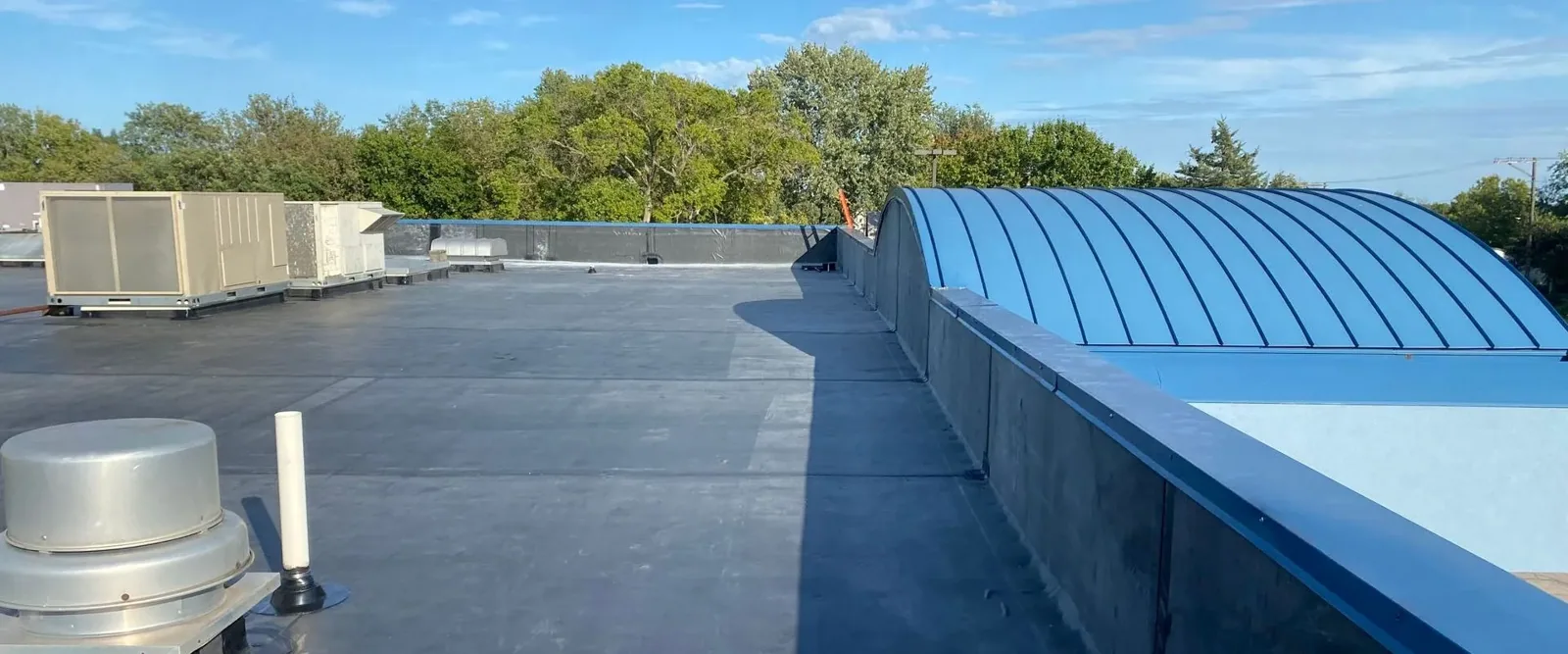
Inspection findings: what the walk records
The walk follows a set route. We start at drains and the drain plane. Then we probe seams along each roof zone. We check flashings, curbs and penetrations last. Findings go on the roof plan with a photograph and a position. Open seams are measured in feet. Shrinkage gaps are measured in inches.
If the surface cannot explain a stain, we test. Wet insulation shows up on an infrared moisture survey as a warm patch after sunset, and a test opening proves it. The result sets the wet boundary. A dry roof with local faults takes repair. A wet roof moves toward recover or tear-off, depending on the deck and the layer stack.
Access is logged. We record the hatch or ladder, the lift reach and who holds the key. A roof off Old National Highway with a locked hatch costs a visit if nobody is on site. We confirm the access window before the date is set.
Scope options: repair, recover or replace
Repair fits local failures on a dry roof. We re-weld seams, patch punctures with rounded corners and rebuild flashings. A recover fits a sound deck under dry insulation. A new sheet goes over the old one with a cover board between. Replacement fits wet insulation, a damaged deck or a sheet past repair.
Georgia's state minimum codes now include the 2024 IBC with Georgia amendments, and the City of South Fulton dates its own start to January 1, 2026. On energy, the 2015 IECC with Georgia amendments is still the standard. A replacement that changes insulation is checked against both. The scope lists the questions before the permit is filed.
Cost follows the area, the layers removed, the insulation depth and the number of penetrations. Wet insulation adds removal and replacement of board. A damaged deck adds a repair line. Each driver is listed in the scope as its own item.
Access and sequencing: heat, storms and trades
Heat and humidity shape the work window. Welding needs a dry sheet. Morning dew and afternoon storms can close a window fast. We start early and stage material near the access point. Hail peaks in April, with about seven large-hail days a year across the NWS north and central Georgia area, and tornadoes cluster in March, April and May. Spring work gets a fallback date.
For a general contractor, the roof is a trade handoff. Mechanical contractors need curbs set before the sheet. Electricians need conduit flashed. A dry-in limit and a close-in point are set for every phase, which keeps any section from sitting open overnight. Buildings along the Fulton Industrial District and South Fulton Parkway follow the same sequence.
On a distribution site, roof phases are tied to the loading schedule, and the dry-in limit is set before work starts.
Related systems and records
TPO sits beside PVC and EPDM in the single-ply family. Each has its own seam method and its own aging pattern. When a job is done, the owner receives photographs, a plan marked with the repair boundary, test results and product data. A condition report tracks the roof between jobs.
Send the roof plans and the access window
How can I tell if TPO seams are failing?
Look for lifted edges, gaps at laps and dirt lines along seams. A blunt probe run along each lap finds unbonded sections. We recommend probing the sun-facing slopes first, since heat movement opens weak welds there before the rest of the roof.
Can a TPO roof be recovered instead of torn off?
Often, when the insulation tests dry and the deck is sound. A moisture survey and a test opening settle it. If the board is wet, the wet section comes out first. We recommend the survey before any recover bid is accepted.
What does shrinkage look like on TPO?
The sheet pulls away from walls and curbs. Flashings tent and gaps open at terminations. Measure the gap at several walls and photograph it. A gap that grows between visits means the roof is moving toward failure.
Does a hail or wind report prove damage?
No. NWS data describes the region, not one roof. Dated marks, counted and photographed on the roof, support a repair or a claim. Inspect after the storm and keep the photographs.
When is the best time to repair TPO?
A dry morning with steady temperatures suits welding best. In South Fulton that often means early hours between spring storms. Emergency leaks get a temporary seal at any hour, and the permanent repair follows.