
- Home
- Roofing for Real Estate Investors and REITs
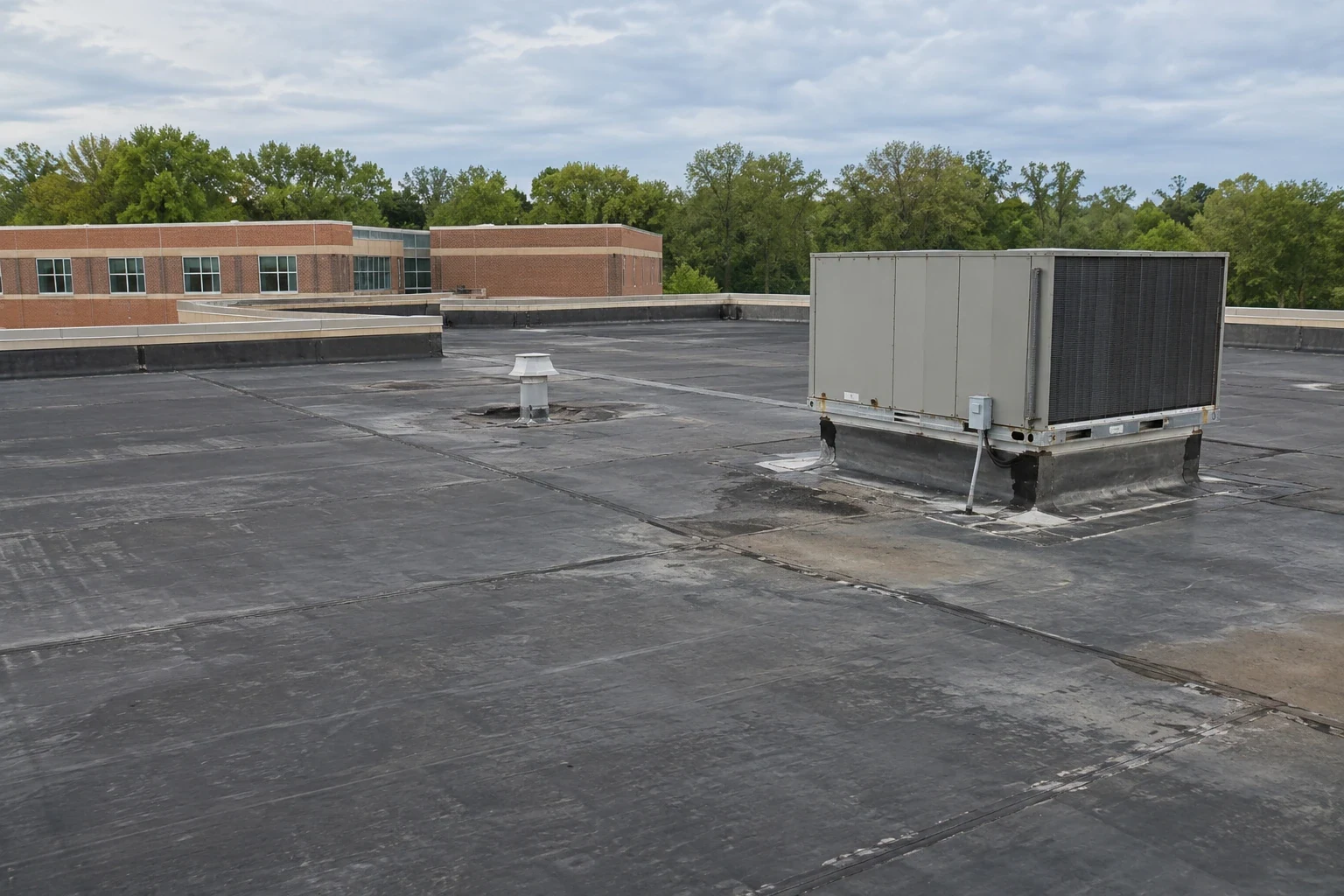
Roofing for Real Estate Investors and REITs in South Fulton, GA
An investor reads a roof as a liability with a date on it. The date is the year the roof stops being repairable and starts being a line in the capital budget. The mechanism that moves that date is moisture. Dry insulation under a worn sheet buys years. Wet board under a good-looking sheet buys none. In South Fulton, GA the first survey sorts which roofs are.
We work for owners, not for a bid. The output is a ranked list, backed by readings and photographs, that can sit in a model or a loan file.
Acquisition survey: what to read before closing
A pre-purchase roof survey has a short list of questions. What is the system? How old is each section? Where is the moisture? What failed before? What does the next ten years cost? The walk answers them with a roof plan, core samples, a moisture scan and a photograph of every defect.
The result sorts each roof zone into repair, restore, recover or replace. Each category carries a price range and a timing window. The buyer sees the reserve needed, not just the asking price. A due diligence roof survey fits inside a typical inspection period when access is arranged early.
Time is the constraint. An inspection period runs a few weeks. Roof access takes days to arrange. Ask for it on the first day. The walk itself runs one to two days per building, and the written record follows. If core samples are not allowed, a moisture scan alone sets a wider range, and the report says so.
Local supply: industrial, flex, retail and office
Buyers here find a range of product. The development authority points to industrial parks, flex buildings, mixed-use projects and office corridors, with over 4,000 developable acres on its books. Next door, the Fulton Industrial District ranks among the biggest industrial areas in the Southeast, by the city's account.
Over the line in East Point, the Camp Creek Business Center has built out roughly 2.9 million square feet of industrial and office space and room for roughly 2.0 million more, while Southmeadow Business Park still has 150 acres to develop. Those are market facts. They do not say what any building's roof is made of. Every acquisition gets its own survey, building by building.

Roof mechanism: what ages a roof here
Georgia summers are long and humid. Surface temperatures on dark or aged membranes run well above air temperature, and daily cycles work seams and flashings. Gusts strong enough to damage buildings turn up in every month and bunch in spring and summer. Large hail reaches north and central Georgia about seven days a year, most often in April.
Those stresses show up as specific marks. Open seams. Tented flashings. Lifted edge metal. Bruised insulation. A survey records each mark with a position and a photograph. It separates storm damage from age. That matters at purchase, because storm damage can sometimes be recovered through insurance and age cannot.
Insulation is the hidden asset on a roof. Once it is wet, it loses its thermal value and holds water against the deck. Drying it in place rarely works. Wet board comes out. That is why moisture is the first reading, and why a sheet that looks fine from the ground can still be a replacement candidate.
Reserve planning: turning findings into capital lines
A roof capital plan converts findings into a calendar. Each roof zone gets a likely action, a window and a range. Repairs fall in the operating budget. Restorations and replacements fall in capital.
The plan shows the cheaper path next to the sturdier one, so the model can carry either. It also names the trigger that moves a roof from one category to the next, such as a moisture reading, a leak count or a failed seam. Triggers are measurable, so the asset manager can watch them. Nobody has to guess when a roof has crossed the line.
Cost drivers are specific to investment property. Roof area and system set the base. Tenant rules set the phasing. Code upgrades triggered by a reroof set the extras. Warranty status sets who may touch the membrane. The plan lists each one, so the model carries the right figure.
Portfolio programs: one format across many assets
Owners with many assets need the same measures on every roof. Our multi-site roof program format uses one zone map, one set of readings and one ranking scale across the portfolio. An asset manager can sort by risk, by cost or by date.
Maintenance follows the same format. A roof asset management record holds each building's history, so a new asset manager inherits facts. Visits are scheduled before the storm peak and after summer. Small repairs happen on the visit. Larger ones go on the list.
Disposition is the other end of the life cycle. A seller with a clean roof file sells faster and answers fewer questions. A roof with a dated repair history, readings and photographs is easier to price. The packet can be placed in the data room as is. General contractors use the same file when a buyer plans renovation.
Code and insurance: what a buyer should confirm
South Fulton permits follow the 2024 code editions with Georgia amendments as of January 1, 2026, and the state energy code remains the 2015 edition as amended. A reroof or major repair can trigger insulation and drainage upgrades, so the survey notes which upgrades a replacement would likely require.
Insurance matters too. A dated record of roof condition helps a buyer talk to an insurer, and it helps a seller defend a claim history. We never promise a claim outcome. We document what the roof shows.
Wind and fire ratings need a look at purchase. The label on the roof, the drawings or a test opening can confirm them. If the rating cannot be confirmed, the report flags it as an open item with a recommended test. A buyer should price that uncertainty, not ignore it.
Warranty status is the last check. Some manufacturer warranties limit who may repair a membrane, and some end if the wrong material is used. Ask for the document. The survey notes which repairs need the maker's approval before work starts.
Send the asset list and the inspection window
What should an investor request before closing on a building?
A roof plan, any prior repair records, the lease terms that touch the roof and access for a walk. We recommend asking for core and moisture access in the inspection period. Without readings, a reserve estimate is a guess.
How do you tell storm damage from age?
By pattern and date. Storm marks cluster and look fresh. Age marks spread along seams and edges. Dated photographs from the first walk set the baseline for later comparison.
Can roof work be capitalized?
That is an accounting decision. The scope separates repairs from replacements and restorations, so your accountant can classify each line.
How often should an asset manager review the roof file?
Twice a year, before the spring storm peak and after summer, with an extra look after any major storm. The file lists triggers to watch between visits.
What does the buyer receive at closing?
The closing file, with a zone map, readings, material data, photographs and unresolved items. It moves with the asset.