
- Home
- Roofing for Manufacturers
Roofing for Manufacturers in South Fulton, GA
A plant roof answers to the production line. The line decides when a section can open. It decides which fans can stop. It decides how much dust the floor below can take. In South Fulton, GA the roofing plan starts with the plant calendar, not the roof plan. Shutdown weeks, changeovers and inspection dates go on the page first.
The mechanism that changes the sequence is process exposure. Steam, oil mist, heat and chemical vapor land on the roof. They age membranes in a pattern. The pattern tells us what to build and what to avoid.
Local manufacturing: strengths and districts
The South Fulton Development Authority names advanced manufacturing and logistics among the city's existing strengths. It cites aerospace-component and large-scale food-production operations, and lists automotive among target industries. The Fulton Industrial District, next to the city, is called one of the biggest industrial areas in the Southeast.
In East Point, Willingham Industrial Park mixes manufacturing, warehousing, automotive repair and recycling uses, and the Camp Creek Business Center is another multi-property employment area close by. Those are market facts. A plant's own roof is another matter. Drawings, cores and a walk decide the assembly, never the sector.
A self-taxing improvement district of property owners spreads over 6,446 acres of commercial and industrial land here, and it spends on freight access along Oakley Industrial Boulevard toward I-85. A plant on the Oakley industrial corridor shares those roads with trucks, and roofing deliveries share them too. The staging route goes on the plan before the first load.
Process exposure: what lands on the roof
Make a list of every unit that vents upward. Note what each releases and how often. Walk the roof with the list. Compare it with the staining. Grease, oil mist and some solvents soften certain sheets. Steam and heat age others. Dust clogs drains.
The comparison picks the roof system. A grease-tolerant sheet suits a food plant. A heat-tolerant sheet suits a plant with hot exhaust. A coating may fit a sound roof, but only if it passes an adhesion test on the contaminated surface. The exposure record stays in the file. When a new line is added, the record is updated before the new vent is cut.
Cleaning is part of the exposure story. A pressure wash aimed at a seam can drive water under a lap. A solvent can soften the sheet it was meant to clean. The plan states the wash method, the interval and who performs it. The same rule covers plant staff, who may clean around fans without knowing what the sheet tolerates.
Equipment and load: what the structure can carry
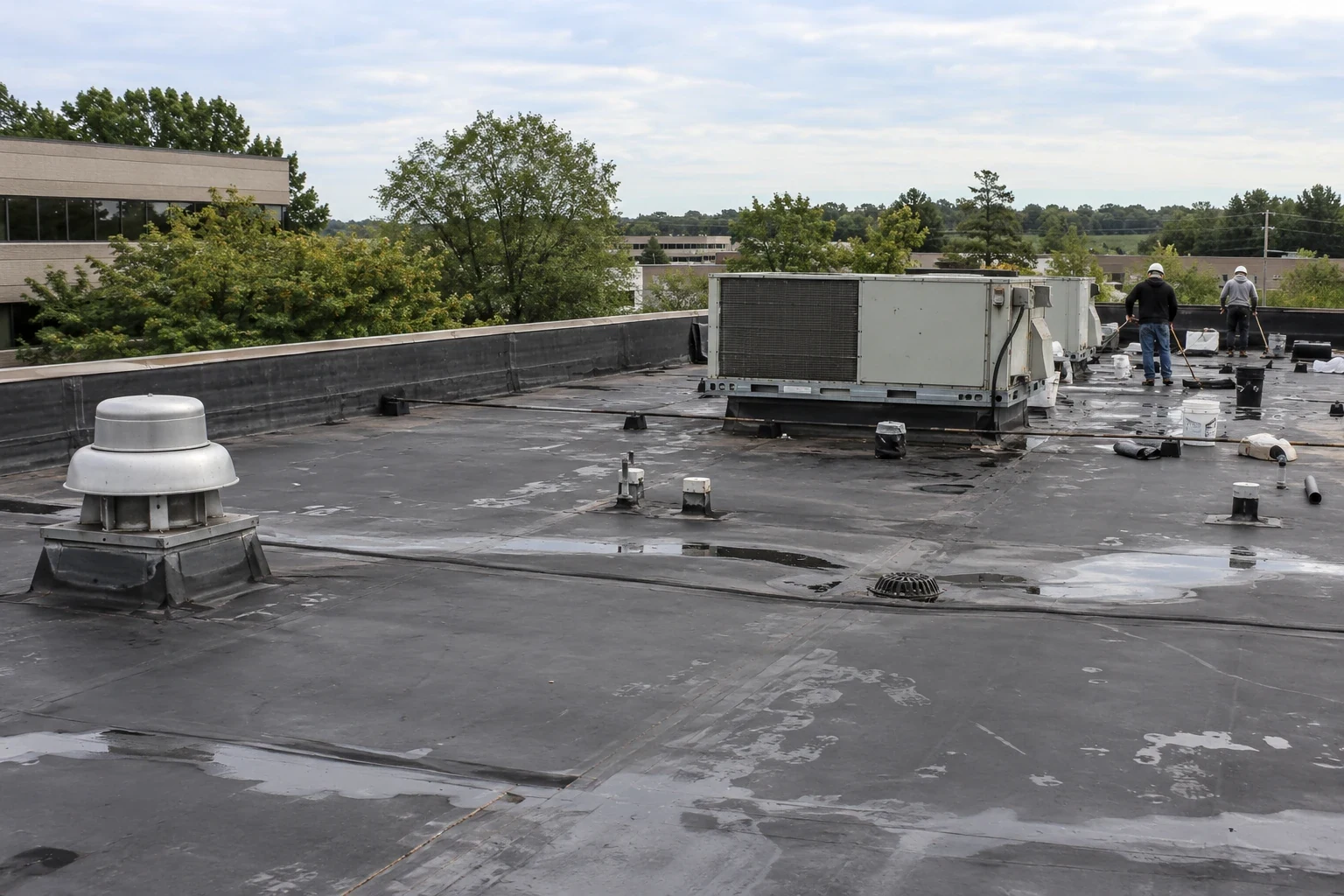
Plants add equipment in stages. Fans, ducts, cooling towers, conduit and platforms accumulate on the roof. Each addition adds load and a penetration. The record tracks both.
For every unit, note the curb, the flashing and the support. Mark supports that rest on bare sheet. Check that sleepers do not dam the drain plane. Ask for the structural drawings before any large addition. A roof near its design load cannot take more dead weight. An equipment curb and support review ties each item to a drawing.
Condensation is the other trap. Humid process areas push moisture up through the deck, and drips along purlins look like roof leaks when the membrane is intact. Look at the underside where access allows. Then look at the topside. The finding records which side the water came from before any repair is assigned.
Phasing around production: shutdowns, hot work and lockout
The plan is built in phases that match shutdown windows. Each phase opens a section, finishes it and closes it before production restarts. Hot work needs a permit and a fire watch. Rooftop units need lockout and tagout, performed by plant staff. Intakes near the work are covered.
Write each handoff. Plant engineers shut down units. Electricians lock out. Mechanical contractors disconnect. The roofer closes the curb. The inspector signs. The access log records the person and the time for every step. When a shutdown slips, the dry-in limit tightens. The crew closes the section and waits, rather than leaving a roof open to a forecast.
Cost drivers sit in the plant, not just on the roof. Shutdown hours cap the work per window. Lockouts cap the number of units that can be worked at once. Intake covers and fire watch add labor. Each line is priced separately. The plant sees which rule drives the number.
Weather: the storm calendar and the heat
Damaging wind occurs in every month here, and spring brings hail and tornadoes. South Fulton took an EF-2 tornado in March 2018. Summers are long, hot and humid. Plant roofs run hotter than the air, since dark equipment pads and exhaust warm the surface.
Plan shutdowns with the calendar in mind. A shutdown in April carries more storm risk than one in October. Secure corners and edges first. Wind damage begins at those points. Every open section is given a firm dry-in limit and a tested temporary seal.
Plant roofs also catch what the weather moves. Wind lifts light debris from storage yards and drops it on the roof. Hail bruises soft insulation under a sheet that looks fine. After a storm, the walk checks drains first, then edges, then the field, and the findings are dated.
Options: repair, restore, recover or replace by bay
A plant roof is rarely one decision. Older bays may be past repair while newer additions are sound. The moisture scan and test openings set the boundary. Dry bays with local faults take repair. Dry bays with a tired surface may take a coating restoration. Wet bays take replacement.
Each path is priced with its duration and records. The plant compares them against the production calendar and the capital plan. Phased replacement spreads the cost and the risk.
Warranty status enters the review. Warranty terms can restrict who repairs a membrane and with what. Send the document early. Methods are matched to the system, and items needing the maker's sign-off are flagged.
Send the shutdown calendar and the vent list
What information do you need from the plant first?
A list of units that vent upward, what each releases, the shutdown calendar and the roof plans. We recommend adding the structural drawings if equipment will be added. With those, the exposure record and the phasing plan can start.
How does exhaust change the roof system?
It changes which sheet or coating will last. Oils and solvents soften some membranes. Heat and steam age others. The exposure record picks a system that tolerates what the plant releases.
Can the roof be worked while the line runs?
Sometimes, over low-risk areas, with lockout for any unit in the work zone. Over sensitive processes, the work waits for a shutdown window.
What if a shutdown slips?
The crew closes the open section, tests the temporary seal and waits. The dry-in limit does not move. The next window picks up where the log stopped.
What does the plant keep after the job?
The exposure record, zone map, readings, product data, access log and photographs, with open items and the next inspection date.