
- Home
- Data Center Roofing
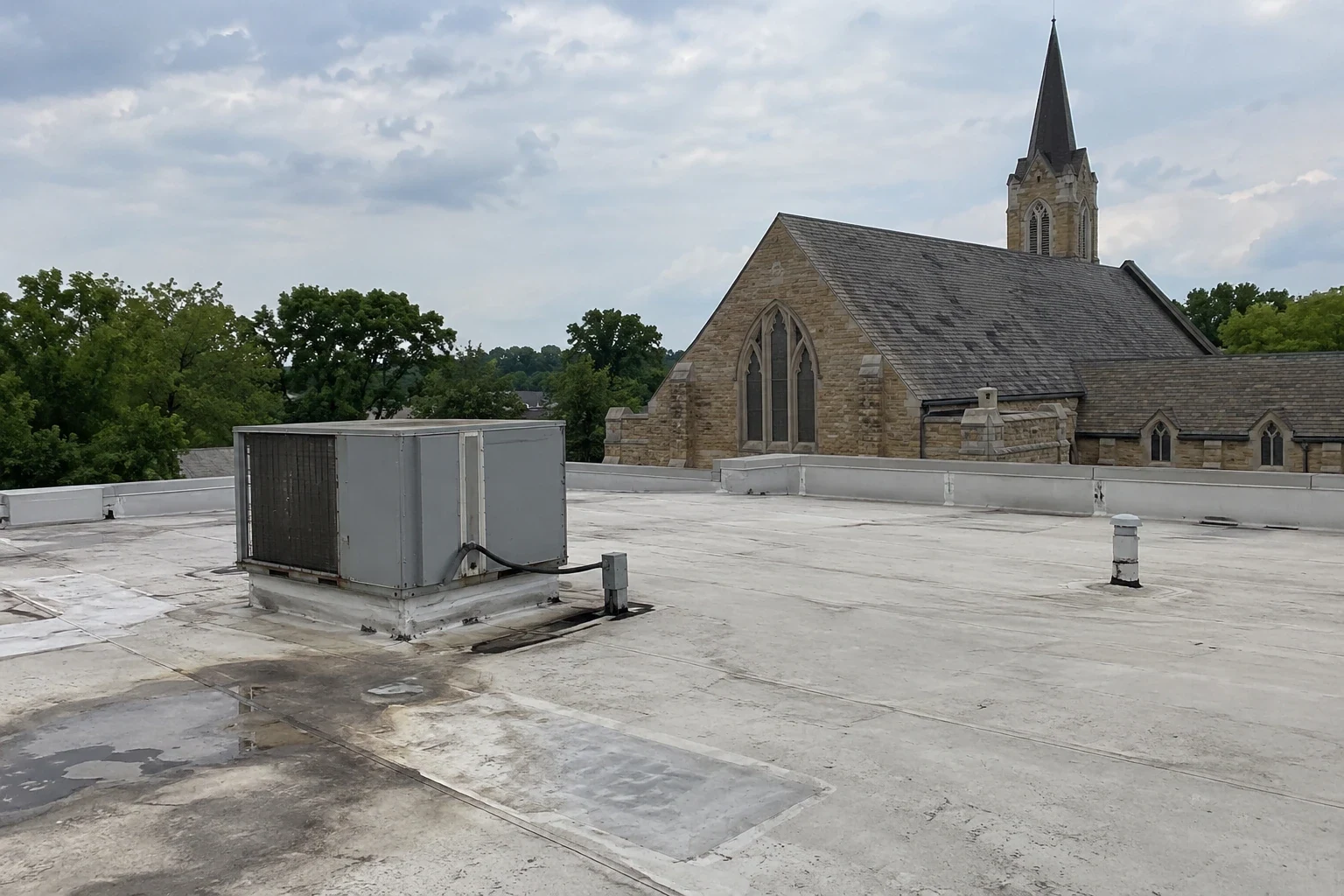
Data Center Roofing in South Fulton, GA
A data center roof shelters a room that cannot get wet. The use sets the first question: where is the white space, and what hangs above it? The zone over the server halls gets the strictest plan. The mechanism that changes the sequence is consequence, because a small leak elsewhere is a repair while the same leak over live equipment is an outage. The first walk ranks every roof zone by what sits under it.
Business services, such as back-office operations and customer-care centers, are an emerging sector for South Fulton's development authority, which also lists logistics, manufacturing and corporate services among the workforce strengths of the wider Atlanta labor market. The city sits about 15 to 20 minutes by drive from Atlanta. Those facts make technology space a reasonable thing to plan for, but the roofs themselves are read one at a time.
A warehouse shell converted to technology use raises a separate question. Its roof was laid for a different load, and its seams, drains and penetrations were picked for storage. The roof is re-rated for the new use, zone by zone, before any conversion plan leans on it.
Roof mechanism: ranking zones by consequence
The white space and the critical rooms are drawn onto the roof plan, and each roof zone is ranked. Zone one sits over live equipment. Zone two sits over support space such as power and cooling rooms. Zone three is everything else. Inspection frequency, repair order and temporary protection follow the rank, and a small zone-one defect is repaired ahead of a larger one elsewhere.
The ranking drives drainage too. Primary and secondary drains over critical zones are checked often, and overflow paths are traced so that any water leaving the roof does so away from the white space. Ponds near critical zones are measured after rain, and the record carries each reading with its date.
Moisture monitoring backs up the ranking. Sensors in the assembly or beneath critical zones report the first sign of wetting, and we help place them where the plan shows the highest risk. A sensor is one tool, and the walk still comes first.
Rooftop cooling, generators and conduit
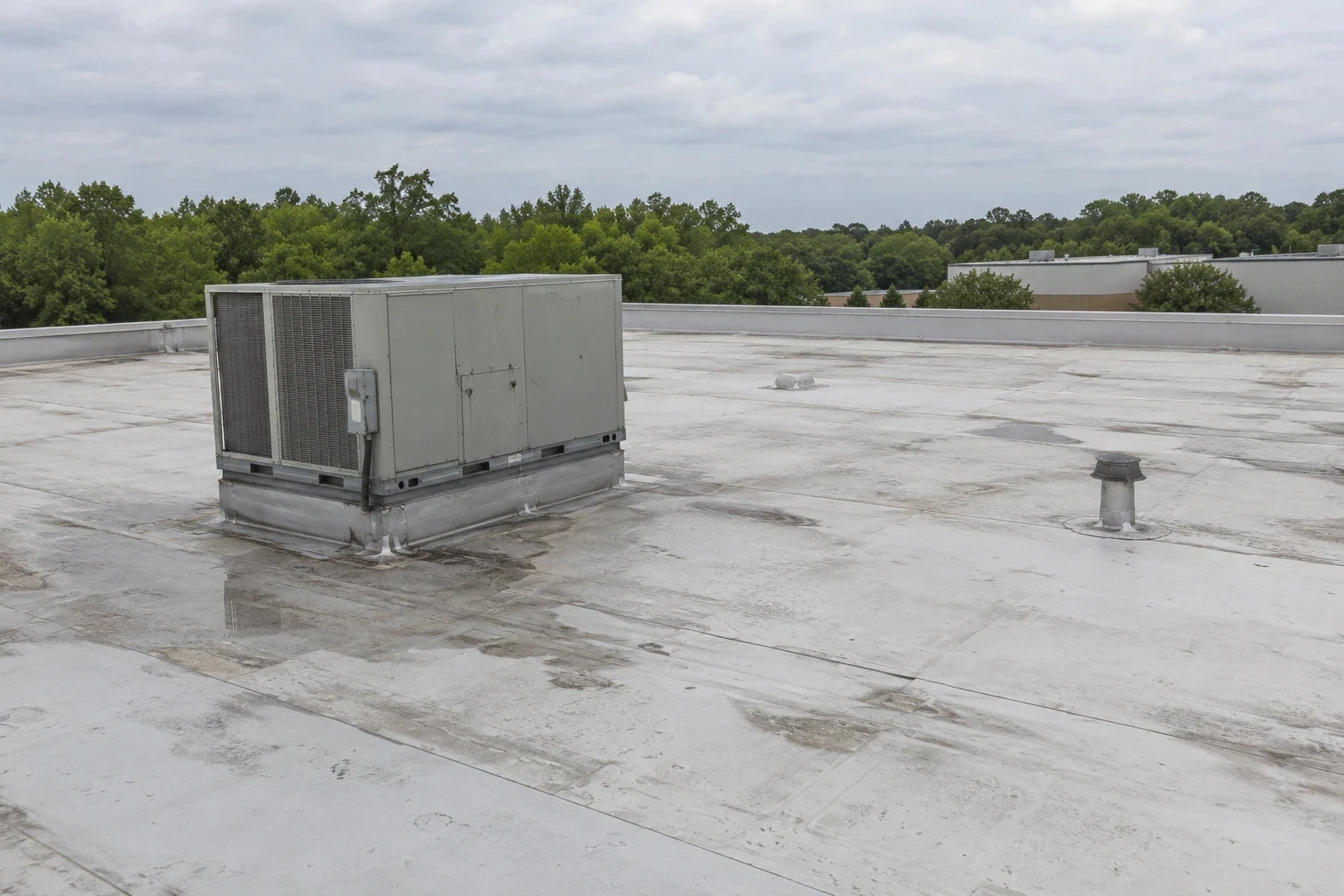
Roofs on these buildings tend to carry chillers, condensers, exhaust and conduit. Those loads are heavy, they vibrate, and they need constant service. Every curb and support is a leak risk. Pipe penetrations may carry water lines, so what looks like a roof leak can be a mechanical one. Every stain is traced to its source before a repair is chosen.
Curbs are checked for settlement and flashing for cracks. Walk pads protect service routes, and heavy loads are reviewed against the structural drawings before anything changes. A curb and support check goes with every walk. Pipe boots are pull-tested and logged, and condensate and drain lines from equipment are routed away from the membrane.
Redundancy matters on the roof as it does inside. A single drain over critical space is a single point of failure. We list any zone served by one path only and check whether secondary drains and overflow scuppers exist, because adding a path costs little next to an outage.
Generator exhaust and fuel vents add heat and vapor. Flashing nearby is checked for scorching, and each penetration is logged with its condition. Repairs near fuel lines follow the facility's own safety rules.
Weather and storm peaks
Building-damaging wind shows up in the Peachtree City warning area about 19 days a year, in every month, strongest in spring and summer. Large hail visits north and central Georgia roughly seven days a year, peaking in April. Tornadoes are recorded in all months and most often in March through May. NOAA calls Georgia summers long, hot and humid.
Hail can crack a membrane over critical space without a leak showing the same day. After a major storm we walk the roof, count marks per test square and run an infrared moisture survey over the critical zones. The storm report prompts the visit, and dated findings on the roof support any repair or claim.
Rooftop cooling gear adds its own heat. The membrane near a condenser runs hot, and we compare it with the field, logging staining, softening or shrinkage. Flashing beside a hot unit ages faster than flashing far from one.
Noise and vibration matter too. Some operators limit both near sensitive gear, so tear-off tools, hammer drills and lifts are scheduled for hours the operator accepts, and dust control protects intakes on the roof and at grade.
Scope options and approvals
Local faults take repair in a short window. A sound roof with dry insulation can take a coating or a recover. Wet board over any critical zone calls for tear-off of that zone with a temporary roof ready. Each option is shown with its cost drivers and its risk to operations.
Since the start of 2026 the city applies the 2024 IBC and companion codes as amended for Georgia; energy compliance still runs through the 2015 IECC and its supplements. Facility rules for hot work, fire watch and change control may add approval steps, and the scope lists them up front.
Cost drivers include temporary roofs, monitoring, off-hours labor and the phasing that critical space needs. Each is priced as its own line, so an owner sees what the protection adds. Wet board and deck repair are unit-priced.
Insurance and contract terms also shape scope. The decision file records what was found, what was done and what was monitored, in language an insurer or a customer auditor can follow.
Access and sequencing: control and monitoring
Access is controlled, with badges, escorts and logs. The crew list goes ahead of mobilization, and tools and materials may be inspected at the gate. Rules and hours are confirmed on the first call, and every entry lands in the access log. Hot work is often barred over live space, so cold-applied and mechanical methods are specified.
A reroof over live space uses a temporary roof or a monitored dry-in. Leak sensors under the work can alert the operator. Each phase is small, closed the same day and inspected before the crew leaves. An office building roof on the same site gets a lighter plan. At handover the owner receives photographs, the ranked-zone plan, test results and product data.
A multi-property business park such as the Camp Creek Business Center, reached from I-285 along Camp Creek Parkway and Washington Road, adds gate and delivery routing to the same method.
Closeout includes the zone ranking, the sensor map if used and a maintenance calendar tied to the ranking. A medical office roof or any critical-use building can use the same format.
Send the roof plans and the access window
How is equipment protected during a reroof?
By zone ranking, small phases, temporary roofs or monitored dry-ins, and leak sensors where the operator allows. A written protection plan, approved by the facility team before work begins, ties those pieces together.
Can hot work be used over a live data hall?
Usually not. Cold-applied and mechanically attached systems are specified instead, and the fire-watch rules are agreed in writing. The facility's own change-control policy is read before any method is chosen.
Why rank roof zones at all?
A defect over live equipment costs far more than one elsewhere. The ranking sets inspection frequency, repair order and temporary protection, and it goes on the plan so everyone works from the same list.
What if a leak turns out to be a pipe?
The water is traced to its source before the roof is repaired. A leaking line near a penetration can pass for a roof leak. The record shows how the source was found.
Does a storm report prove damage over critical space?
No. It is a reason to inspect. A moisture survey runs over critical zones after storms, and the findings document what the roof actually shows.