
- Home
- Cold Storage Roofing
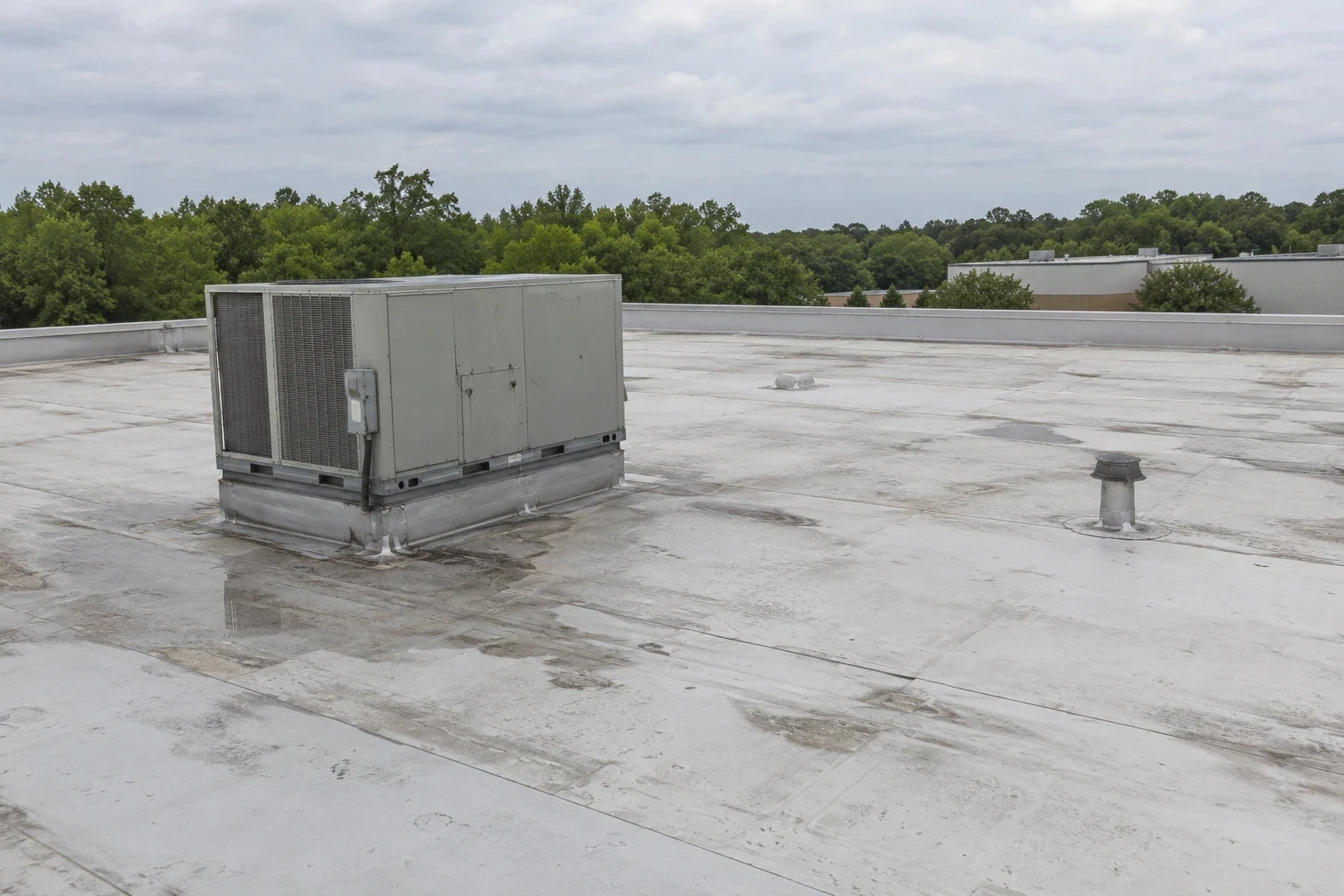
Cold Storage Roofing in South Fulton, GA
A cooler or freezer sits under a roof that bakes through a Georgia summer. The use sets the first question: how large is the temperature difference across the roof deck? The zone over the cold rooms gets the closest plan. The mechanism that changes the sequence is vapor. Warm humid air outside pushes moisture toward the cold space, and any gap in the vapor retarder lets it condense inside the insulation.
South Fulton's development authority lists large-scale food production among the city's existing strengths, beside logistics and distribution. Food handling and distribution both lean on temperature-controlled space in general. The layer stack of a given building still comes from a core sample and a moisture survey, never from the business inside.
Part of the Camp Creek industrial-commercial area lies within city limits, and the Fulton Industrial District borders South Fulton. The first call asks which rooms run cold and where their roofs lie.
Roof mechanism: vapor drive and condensation
Vapor moves from warm to cold, and on a cold storage roof that direction points downward into the room. Moisture that reaches cold insulation condenses or freezes. Over time the board soaks, loses insulating value and can frost the underside of the deck. The retarder and the sealed penetrations are the only things stopping it.
NOAA describes Georgia summers as hot and humid, and Atlanta tops 95°F on roughly seven days a year. Outside heat and humidity raise vapor pressure against the roof, which is reason enough to inspect seals. Every conduit, pipe and cable that crosses the retarder is listed with its condition.
Cold roofs carry thick insulation, often in several layers with staggered joints. A cover board on top protects the foam and spreads foot-traffic load. Each core shows whether one is present, and the layer stack goes on the plan with a photograph.
Slope matters too. A cold roof that drains poorly keeps water against the sheet, and every wet day pushes more moisture toward any weak seam. Tapered insulation and clear drains reduce that exposure, so the drain plane is mapped alongside the layers.
Inspection findings: wet board, frost and failed seals
Trouble shows inside and out. Indoors: frost on the underside of the deck, ice growing at a penetration or drips at a joint. Outdoors: a sagging membrane, soft spots underfoot and blisters. We mark the soft spots and photograph them. An infrared moisture survey maps wet insulation, and cores confirm it.
Wet insulation in a cold roof is a serious finding. It raises energy cost and loads the deck. The repair boundary follows the wet area plus a margin. New board goes in, and the retarder is rebuilt and sealed at every edge and penetration. The retarder is photographed before it is covered, since it disappears afterward.
A leak into a cold space is urgent because water freezes and expands in the insulation. Emergency roof repair response runs around the clock, holidays included. The first move is a temporary seal and a catch plan below, and the permanent repair follows once the cause and the wet area are mapped.

Refrigeration equipment and penetrations
Refrigeration puts condensers, evaporator vents and piping on the roof. Each item brings penetrations, vibration and foot traffic. Pipe supports and curbs must carry weight and let the lines move. Support condition, flashing and line insulation are checked, since a cracked boot feeds moisture straight into the cold side.
Walk pads follow service routes and curbs are probed for movement. Where new equipment is planned, load and penetration plan are reviewed first, and the structural drawings set the limit. Seals around penetrations are photographed before closing.
Condenser heat acts on the roof as well. The membrane near a condenser runs hotter and its flashing ages faster, so we compare that sheet against the field and record staining, softening or shrinkage. Condensate lines are routed to drains and kept off the membrane.
Weather and storm peaks
Damaging thunderstorm winds cross the Peachtree City warning area in all twelve months, about 19 days a year by NWS count. Large hail hits north and central Georgia on roughly seven days a year, with April the peak, and tornadoes are possible in any month with March through May the busiest.
A small breach over a cold room lets humid air and rain in together. After strong storms we inspect and seal any opening the same day. Edges, copings and penetrations are checked first, and dated marks on the roof support a repair or a claim.
The record sets the roof against earlier photographs. A new tear or lifted edge stands out in a side-by-side, and the same comparison shows whether an earlier repair is holding.
Scope options and sequencing
Local faults take repair and re-sealing. Wet board in one zone calls for a section replacement with a new retarder. Wet board across the building calls for full replacement, often phased so product stays cold. Permits here follow the 2024 IBC with Georgia amendments, effective January 1, 2026, while energy compliance rests on the older 2015 IECC as amended.
A roof opening exposes the cold space, so each phase is sized to finish and seal within a day. Weather windows are short in a humid climate, which makes the dry-in limit a daily number. Dock-side access follows the approach used on a distribution center roof, and sites along South Fulton Parkway follow the same sequence. A recover seldom suits a wet cold roof.
The calendar matters for cost. Humid weeks stretch the schedule because adhesives and sealants need dry surfaces, and each lost day on a phased cold roof means another day with an open section to protect.
Cost drivers are the retarder, insulation depth, penetrations, access and the phasing the product allows. A warehouse roof has fewer layers, which is a useful comparison. At turnover the owner receives the retarder photographs, test results and product data.
Send the roof plans and the temperature zones
Why does a cold storage roof get wet from the inside?
Warm humid air drives moisture toward the cold side, and gaps in the vapor retarder let it condense in the insulation. Sealing every penetration and rechecking the retarder whenever the roof is opened is how the problem is kept out.
How is wet insulation found without opening the whole roof?
An infrared survey maps likely wet areas and cores confirm them. Each core is patched and sealed the same day. The results are then checked against frost and drip locations inside the building, so the scan and the room tell the same story before a boundary is drawn.
Can product stay cold during a reroof?
Yes, with phases sized to close within one day. Each section is sealed before the shift ends. Product and temperature limits are agreed on the first call. If a section runs long, the temporary seal holds until the next shift, and the retarder is never left exposed overnight.
What happens when a storm opens the roof?
The opening is sealed the same day, then we trace what got wet. Humid air and rain both hurt the cold side, so speed matters. Photographs are taken of everything, and the wet area is mapped so the repair follows the real boundary, not just the visible tear.
Does a hail report prove a cold storage roof is damaged?
No. It is a reason to inspect. Dated marks and openings, photographed by roof zone, are what support a repair.