
- Home
- Seam Failure Repair
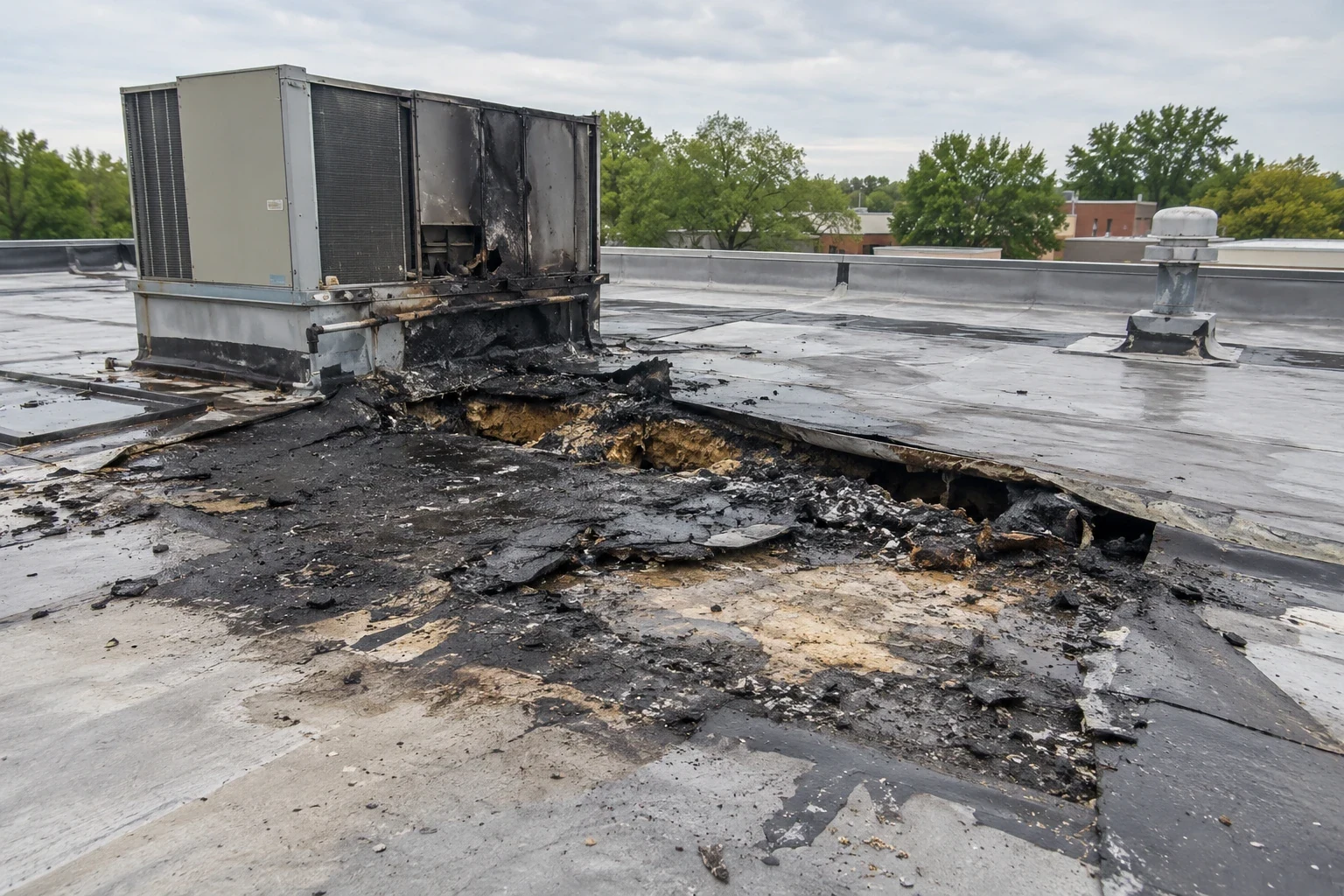
Seam Failure Repair in South Fulton, GA
A seam is the weakest line in a sheet roof, and it is the line the sun works on every day. Atlanta tops 95 degrees on about seven days a year, and South Fulton, GA sits in the same long, hot, humid pattern. Membrane that expands at noon and shrinks at midnight pulls at every weld, lap and lock. A seam does not open all at once. It creeps, and a probe finds the creep before water does.
Building use: seams over sensitive space
Seam failure matters in proportion to what lies below. A retail roof near the Camp Creek Shopping District, where East Point places retail and dining along both sides of the parkway, sits over open sales floors and kitchens. Water that enters a seam there reaches product and customers. A seam over a mechanical room endangers equipment, and a seam over a dry storage bay endangers racking and stock.
In Riverdale, the city's economic-development office seeks to support healthcare, financial services, manufacturing, distribution and retail. Those uses differ in tolerance for moisture. A medical suite and a parts warehouse do not call for the same response time. We rank seam repairs by what is beneath them, then by how fast the seam is moving.
Roof mechanism: how a seam is made and how it fails
Seams are built in different ways. Thermoplastic sheets are welded with hot air, forming a homogeneous bond. Modified bitumen laps are heated or bonded with adhesive. Built-up roofs overlap plies with asphalt. Standing seam metal panels lock together along raised ribs, and a sealant bead or a mechanical crimp closes them. Each seam type has a different failure mode, so the repair method changes with the system.
A weld fails when it was cold, contaminated or under tension. Thermal cycling then opens it from the end. A lap fails when the adhesive dries or the lap lifts under wind. A metal seam fails when a crimp relaxes or a sealant bead cracks. In each case, the open edge is easy to see once exposed, but the wet boundary runs well beyond it, and the layer stack below the seam is where the damage often lives.
Single-ply systems like PVC and TPO depend on clean surface preparation. A repair weld over dirt or chalking will fail again in a season.
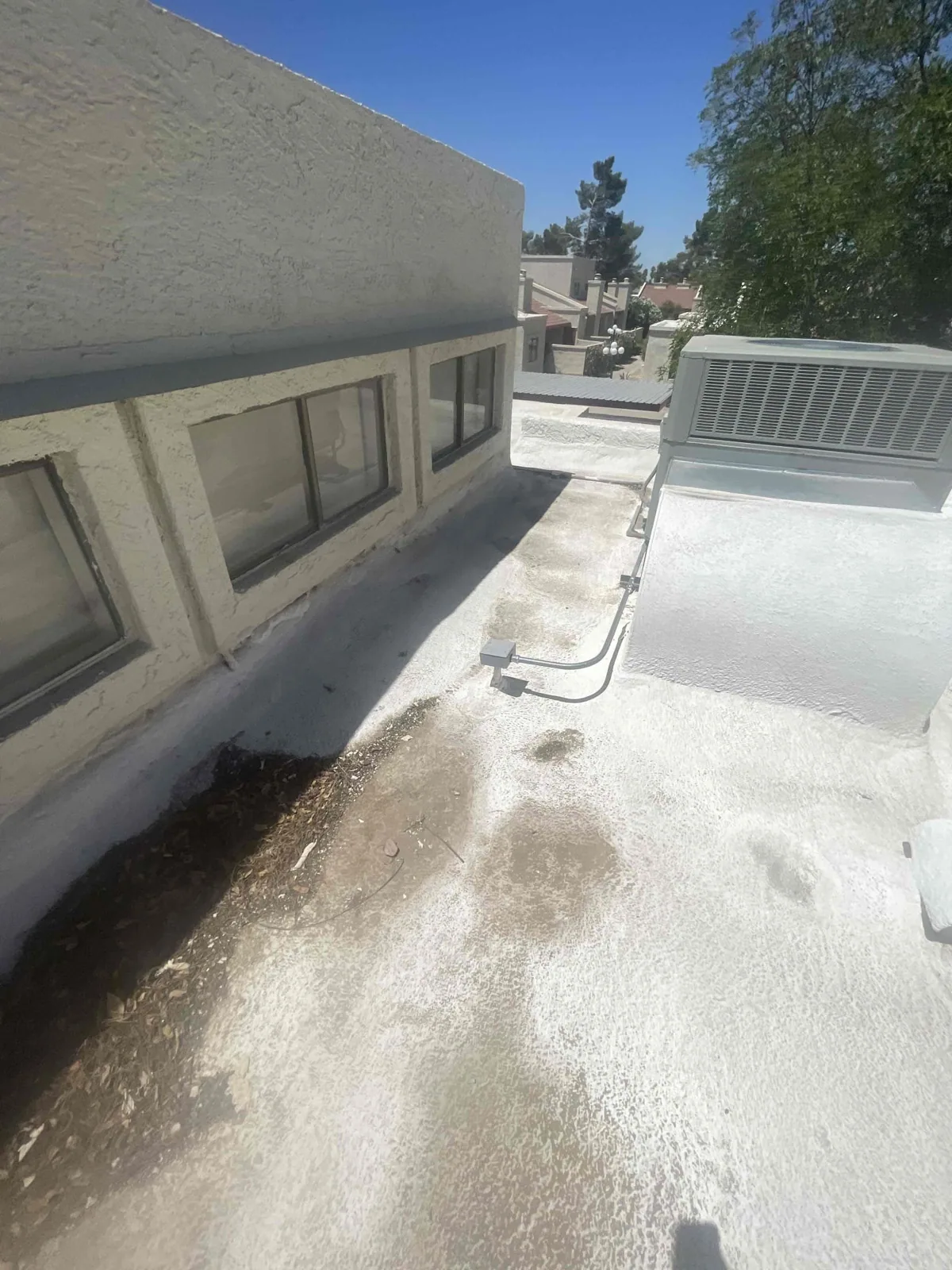
Inspection findings: probing every line
We probe seams with a rounded tool at a measured pressure. A good weld resists. A cold weld lifts. We mark the length, note the gap, and photograph the line with a scale marker. Seams at the ends of laps, at T-joints and over fastener plates get the closest look because those are the points where stress concentrates.
- Open edges where the lap has lifted and left a visible gap.
- Fishmouths, where the edge of the sheet curls away from the seam.
- Shrunken membrane pulling a seam into tension at the wall.
- Cracked or shrunk sealant on standing seam laps and trim.
- Stains or dark lines running down the seam path.
An infrared moisture survey maps where water has traveled below the seam. We follow it with core samples or test openings so the repair boundary is set from evidence, not from the visible tear.
Scope options: re-weld, patch, strip, section
A re-weld applies when the seam is clean and the sheet is not aged. We clean, prime if required and weld the lap again with the correct temperature and speed. A cover strip applies when the seam is open over a long run and the membrane is sound beside it. A patch covers a local tear or a corner. A section replacement applies when the sheet has shrunk, hardened or lost its weld ability.
If the seam failure runs across the roof, the pattern suggests a membrane problem, not a workmanship problem. That is the point where a commercial roof repair scope should be compared with a recover or replacement. Repeated seam repairs on an old sheet cost more than a plan to change the system. We price the choices side by side so the owner can choose a path.
Each repair carries a test. After a weld cools, we probe the full length again and photograph the result by roof zone. Any section that fails the probe is redone before the crew leaves, so the record shows a seam that passed rather than a seam that was merely touched.
Access and sequencing: clean, dry and warm enough
Seam work needs a clean, dry surface. Rain stops it. Dew delays it. Humid mornings in the region leave a film on the sheet that must burn off before welding. We schedule seam repairs in the hours when the roof is driest and hottest, and we carry a moisture meter for the substrate and a weld tester for the result.
Foot traffic shortens the life of a repaired seam, so we plan a walk path, protect the new weld with walkway pads where traffic is likely, and brief the other trades. For a building with rooftop equipment, the service route runs on a protected lane. Material loading goes through a staging route that does not cross a finished seam.
Timing: heat, then the afternoon storm
A seam that opens during a heat wave tends to widen with each cycle, so delay turns a short repair into a long one. The wide gap also admits storm water faster than a hairline crack, and wet insulation under the seam adds weight and cost.
Repairs are timed to the season. Summer heat helps adhesives and sealants cure, but the afternoon storm interrupts the day, so we start early and close in by midday. Where a ponded zone lies over the seam, the drainage fix goes first, otherwise the new weld sits under water. And where a flashing failure joins the seam at a wall, we scope them as one joint.
Send the roof plan and the leak locations
How do I know a seam is failing before a leak shows?
Look for lifted edges, wrinkles pulling toward a wall and dark lines along the seam. A probe test confirms it, because a weld that looks closed can still lift under a rounded tool. Once the line is mapped, the repair can be scheduled before water gets into the insulation.
Is a hot-air weld stronger than adhesive on a seam repair?
Neither wins everywhere. Thermoplastic membranes accept a weld when clean, and the bond becomes part of the sheet. Older sheets may need a bonded cover strip. The manufacturer's repair instructions set the method, and we follow them for the system on the roof.
Our roof has hail history. Could seams be affected?
They can. Hail bruises the sheet and can fracture reinforcement near a seam, and impact stress loosens a weld that was already marginal. After a hail event, a seam probe and a moisture check are part of the survey. The result separates storm damage from age.
A standing seam roof is leaking at a lap. Is resealing enough?
Resealing works if the panels sit flat and the clips hold. If the panels have moved or a fastener has backed out, the seam will reopen. We check clips, trim and expansion room first, then decide whether a sealant, a crimp or a panel repair is the right fix.
How many seams can be repaired before replacement makes more sense?
There is no fixed count. The pattern matters: a few isolated failures near details point to local causes, while failures across the field point to an aged membrane. We compare the cost of repeated repairs with a recover or replacement and give the owner the comparison in writing.