
- Home
- Restaurant Roofing
Restaurant Roofing in South Fulton, GA
The exhaust fan is the first thing to check on a restaurant roof. Grease leaves the kitchen through that fan and lands on the membrane around it. Over months it softens some roofing materials and hides cracks under a film. In South Fulton, GA, heat speeds the process. A restaurant roof is small, but it works harder than most. The plan starts at the fan and moves outward, one numbered roof zone at a time.
Building use: kitchens, dining rooms and rooftop units
A restaurant roof sits over three things: a kitchen with hot, greasy exhaust, a dining room with ceilings and light fixtures, and mechanical equipment. Each has its own risk. A leak over the kitchen reaches cooking lines and electrical gear. A leak over the dining room reaches guests and the ceiling. A leak over a cooler or storage area reaches food.
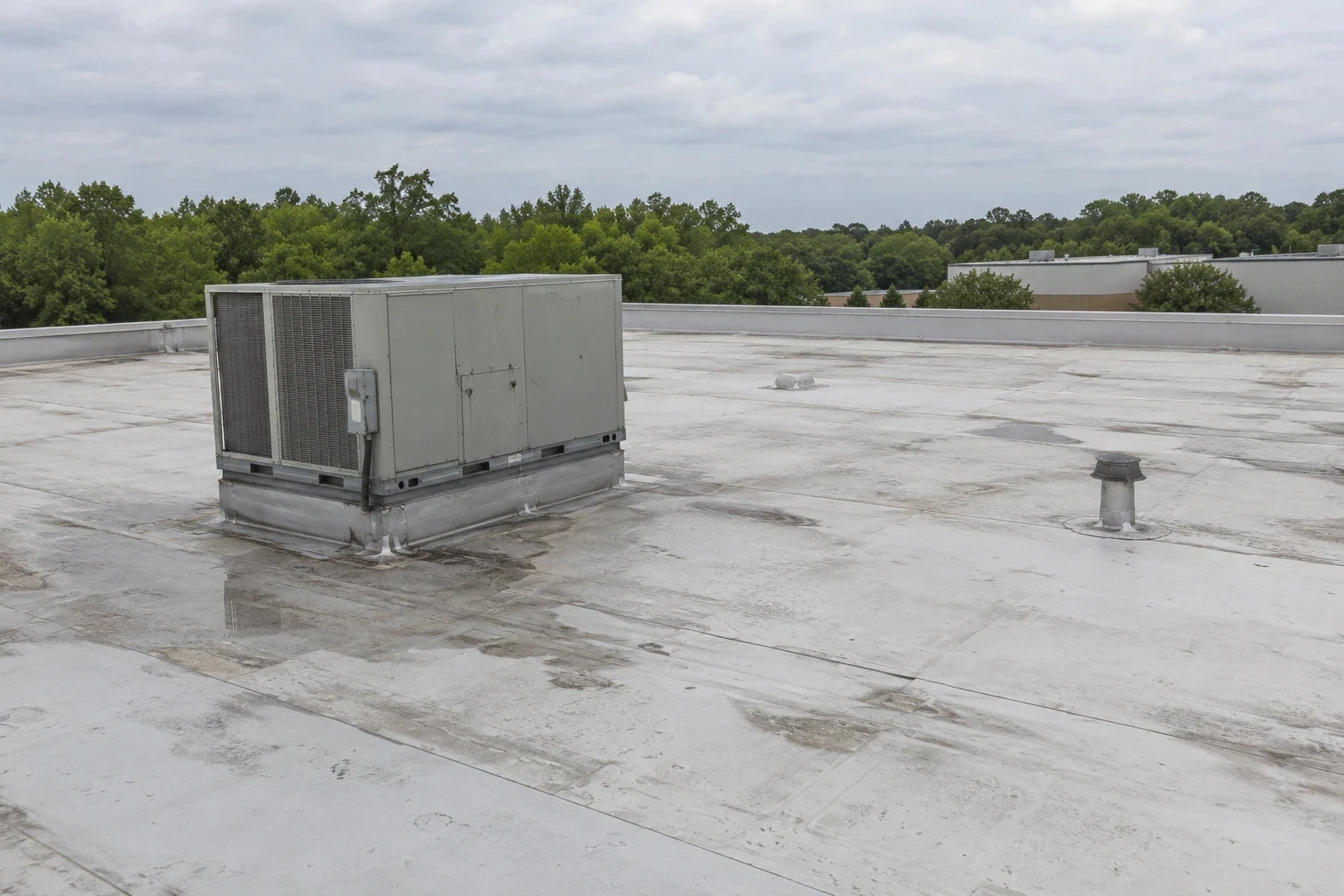
The roof is usually small compared with other commercial buildings. That makes each penetration count for more. Exhaust fans, makeup air units, grease containment, plumbing vents and rooftop units crowd the surface. Each is a flashing detail.
Roosevelt and Old National highways are the established business districts, and about 500 establishments line the Old National Highway corridor, per the merchants association. A restaurant on that corridor is read from the fan outward, whatever the address.
Freestanding pads and in-line suites behave differently. A pad owner controls the whole roof. A tenant in a strip shares one, as in shopping center roofing.
Roof mechanism: grease, heat and thin margins
Grease is the first mechanism. Exhaust vapor cools and settles on the roof. Some membranes soften or swell under repeated exposure. Fans without a grease container let it run across the surface. A PVC membrane is often chosen near kitchen exhaust because it resists grease better than many single-ply sheets. The choice still follows the deck and the layer stack.
Heat is the second. Summers in Georgia stay long, hot and humid, and Atlanta tops 95°F about seven days a year. A kitchen adds its own heat below the deck. Insulation and sealant dry out.
Wind is the third. Damaging thunderstorm winds are logged by the weather service for the Peachtree City warning area in every month. A small roof with loose edge metal loses it quickly.
The fourth is service traffic. Hood cleaners and HVAC technicians walk the roof. They drag hoses, set tools on the membrane and leave punctures. Walkway pads help, and a path of pads from the roof hatch to each unit costs little. A puncture repair is quick, but finding the puncture is the job.
Inspection findings: what the first walk marks
We photograph the whole roof, then each fan, curb, vent and edge. Each finding is numbered on the plan.
Typical findings: grease staining and soft membrane near exhaust fans, missing or full grease containers, cracked pipe boots, open sealant at curbs, patches layered on patches, and punctures along the service path. We note whether the fan has a hinge kit, since a fan that tilts for cleaning scrapes the roof.
A stain that may mean wet insulation gets a moisture reading first, then an infrared moisture survey to map the wet boundary. On a small roof, a few test openings may be faster. The wet boundary sets the repair boundary.
After a storm the walk repeats and the photographs are compared. NWS climatology counts about seven large-hail days a year across north and central Georgia, April most often. A hail report is only a reason to look. The photographs say what happened to this roof.
Scope options: grease zone repair, section rebuild, replacement
Many restaurant roofs need a zone repair. The membrane around the exhaust is cut out, the insulation checked, and a grease-resistant patch installed. Grease containers are added or replaced. Fans get hinge kits and curbs get a rebuilt flashing.
If wet insulation is spread across the roof, a section rebuild or full replacement is needed. A small roof makes replacement cost easier to bound. Tear-off, insulation, access, lift time and weather hold are priced as lines.
A curb and support rebuild matters on this building type, since technicians disturb equipment often. We photograph each curb before and after any service visit the owner allows us to witness. That record shows who disturbed what.
A regular maintenance visit is useful. It empties grease containers, cleans drains and checks flashing. The visit takes a few hours. It does not make an old roof new, but it stops small failures from growing, and the dated photographs show how the roof is aging between larger repairs.
Access and sequencing: around service hours
Restaurants run lunch and dinner. Noisy tear-off is scheduled for the morning before opening or on a closed day. Deliveries avoid the rush. Staging sits away from the entrance and the dumpster.
Every shift closes with its section dried in, and a forecast storm closes any section still open. That is the dry-in limit. The kitchen line and the dining ceiling get interior protection if the tenant wants it.
The trade handoff matters. Hood contractors and HVAC technicians disconnect and reconnect equipment. We lift, rebuild the curb and reset. Gas and fire-suppression lines belong to licensed trades. We coordinate timing so the kitchen is down for as short a period as the work allows.
Calls about a leak on a restaurant roof are answered at all hours, holidays included, starting with the dry-in and then the close-in limit.
Code coordination: permits and kitchen rules
Restaurant reroofs in South Fulton are reviewed against the 2024 International Building Code and related 2024 editions as amended by Georgia since January 1, 2026; the state energy code is still the 2015 edition. A replacement is designed to both. Fire and health rules for kitchens belong to other offices, and we keep them in the schedule.
Multi-unit operators can run one specification across locations, as with retail and restaurant chains. Hotel kitchens and banquet exhausts raise the same grease questions on a bigger roof, as seen in hotel roofing.
Send us the roof plan and the equipment list
What does grease do to a roof membrane?
It settles on the surface and soaks into some materials, which softens them. A film also hides cracks. We photograph the area around each fan and test the membrane there. Where wear shows, we recommend a grease-resistant membrane, a container on the fan and a hinge kit.
How often should a restaurant roof be checked?
Twice a year is a good baseline: before the spring storm season and after the summer heat. Grease containers and drains may need more frequent cleaning. Each visit is recorded with photos so the next visit starts from the last.
Can the roof be replaced without closing the kitchen?
Often, with the work done in sections before opening or on a closed day. The hood and HVAC contractors disconnect equipment at agreed times. The kitchen stays down only while the curbs are rebuilt. The schedule shows those windows.
Why do patches over patches keep failing?
Each patch adds thickness and a new edge where water can enter. Grease under a patch prevents a good bond. We strip back to sound material and clean the surface before a new patch goes on. The record shows which patches were removed.
Does a restaurant roof need a different warranty approach?
It needs one that reads the grease exposure. Some manufacturer warranties exclude grease damage unless a containment system is in place. We read the terms first and note what the owner must maintain. The warranty file goes with the roof record.